










What Is an AED? A Complete Guide to Automated External Defibrillators
It's a Saturday morning at a youth soccer game. A parent cheering on the sideline suddenly collapses and stops breathing normally. Someone calls 911, and help is on the way, but the nearest ambulance is about seven minutes out.
Scenes like this happen more than 350,000 times a year in the United States, and about 9 in 10 out-of-hospital cardiac arrests are fatal. Most occur at home, but many happen at schools, offices, gyms, and other places where people gather. For every minute without CPR or a shock, a person's chance of survival drops by about 10%.
That is where an Automated External Defibrillator (AED) comes in. An AED is a portable device that can help restore a normal heart rhythm, and it is designed so that anyone nearby can use it in the minutes before emergency responders arrive. In this guide, we'll explain what an AED is, how it works, who needs one, where you'll find them, and how to choose the right type for your home, school, or workplace.
What Is an AED?
AED stands for Automated External Defibrillator. An AED is a lightweight, battery-powered device that checks a person's heart rhythm and, if needed, delivers an electrical shock to help the heart reset. Most units are about the size of a laptop bag or smaller and weigh a few pounds.
AEDs are built for bystanders, not just medical professionals. Once the lid opens or the power button is pressed, the device gives clear voice prompts, and many also show text or images on a screen. It tells the rescuer where to place the pads, when to stand clear, and when to begin CPR.
Cardiac Arrest vs. Heart Attack: What’s the Difference?
These two terms are often confused, but they are different events. A heart attack is a circulation problem: a blocked artery stops blood from reaching part of the heart. Sudden cardiac arrest (SCA) is an electrical problem: the heart's rhythm becomes chaotic and it stops pumping blood effectively. A person in SCA collapses, becomes unresponsive, and stops breathing normally. An AED is used to treat sudden cardiac arrest, not a heart attack.
What Does an AED Do?
The key to how an AED works is its rhythm analysis: it delivers a shock only when it detects a rhythm that a shock can correct. The two most common irregular rhythms are ventricular fibrillation (a fast, disorganized quiver) and pulseless ventricular tachycardia (a very fast rhythm that does not move blood). The shock stops the chaotic activity so the heart's natural pacemaker has a chance to restart a normal rhythm.
If the heart rhythm does not need a shock, the AED will not deliver one. This built-in safeguard is one reason AEDs are safe for untrained bystanders to use.
How to Use an AED, Step by Step
- Call 911 and send someone to get the AED.
- Start CPR while you wait for the device.
- Turn on the AED and follow its voice prompts.
- Place the pads on the person's bare chest as shown on the pads. (If you see a bump under the skin of the upper chest from a pacemaker or implanted device, place the pad to the side of it, not over it.)
- Stand clear while the AED analyzes the rhythm.
- Press the shock button if instructed, or step back if the AED shocks automatically.
- Resume CPR right away and continue until emergency responders take over.
The American Heart Association describes AED use as the third link in the chain of survival, after calling 911 and starting CPR.
Who Needs an AED?
Sudden cardiac arrest can happen to anyone, at any age, including people with no known heart condition. That is why AEDs are valuable wherever people live, work, learn, or gather.
People Who May Need One Used on Them
Some factors raise the risk of SCA, including:
- A previous heart attack or known heart disease.
- A family history of sudden cardiac arrest or inherited heart conditions.
- Older age, though young athletes can also experience SCA.
- Electrical shocks, drowning, or a hard blow to the chest.
People and Organizations That Should Have One on Hand
- Schools and districts: Students, staff, and visitors at sporting events and assemblies.
- Workplaces and offices: Many organizations add AEDs as part of their workplace safety plans.
- Gyms, churches, and community centers: Places where large groups gather or exercise.
- Families: Households with an at-risk member, or homes in rural areas where emergency response takes longer.
AED Training and Certification
AED certification means completing a CPR and AED course from an organization such as the American Heart Association or the American Red Cross. Many of these courses use a blended format, pairing online learning with a hands-on skills session, and certification is usually valid for 2 years.
That said, you do not need to be certified, or a medical professional, to use an AED in an emergency. The device’s voice prompts are designed to guide anyone through the process, and Good Samaritan laws in every state offer protection to people who help in good faith. Training still builds confidence, which is why many workplaces, schools, and facilities with AED programs require designated staff to stay certified.
Why Have an AED?
The main reason to have an AED nearby is time. Without CPR or defibrillation, a person's chance of surviving cardiac arrest drops by about 10% for every minute that passes.
Emergency medical services typically take several minutes to arrive. A national study published in JAMA Surgery found that the median ambulance response time in the U.S. is about 7 minutes, and rural areas average more than 14 minutes. An AED on site lets bystanders act during that gap.
The results are significant. In a study of nearly 50,000 out-of-hospital cardiac arrests published in the AHA journal Circulation, people shocked by a publicly available AED survived to hospital discharge at a rate of 66.5%, compared with 43% for those who were not. Bystander use of an AED was also linked to better brain function after recovery.
Where Are AEDs Located?
AEDs are most useful when they can be reached and brought back to a patient within a few minutes. You will commonly find them in:
- Schools, colleges, and athletic facilities.
- Office buildings and workplaces.
- Airports, train stations, and shopping centers.
- Gyms, stadiums, and recreation centers.
- Places of worship and community buildings.
- Government buildings, libraries, and police vehicles.
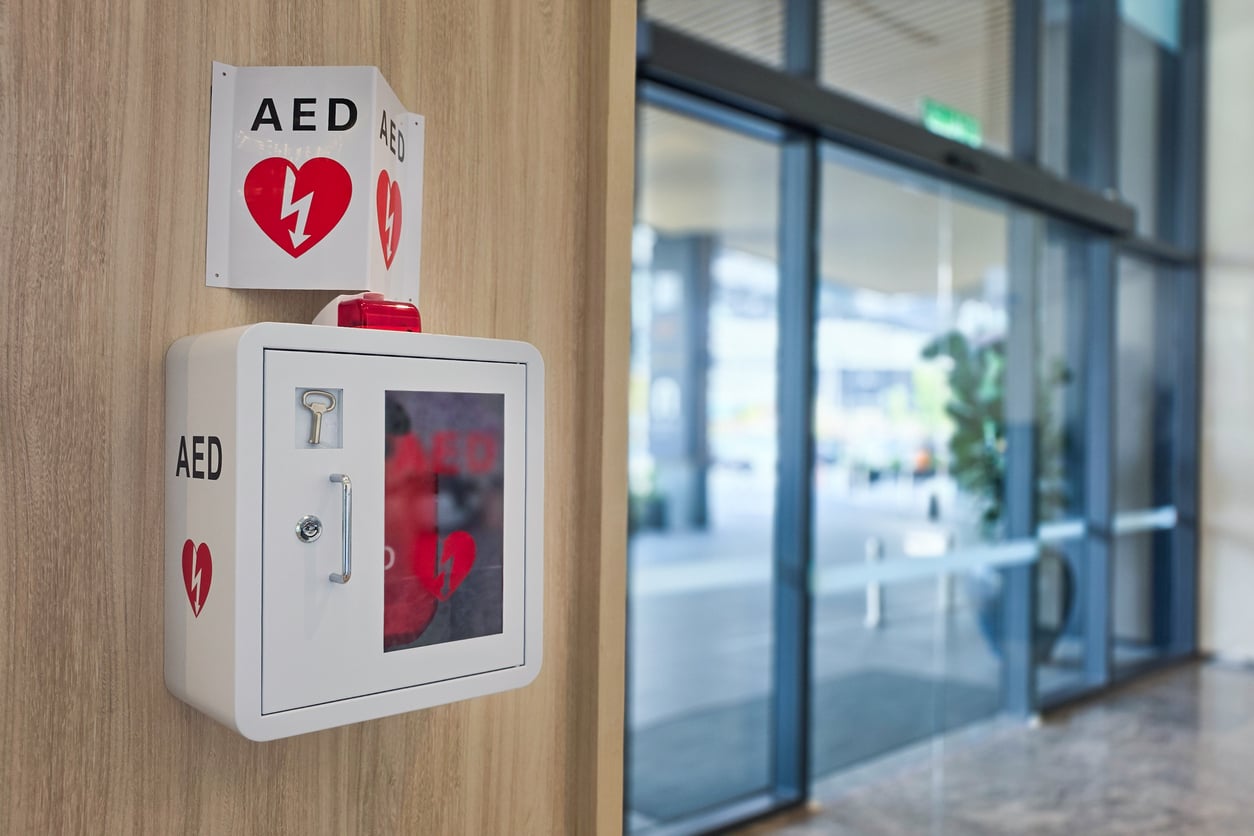
Public AEDs are usually mounted in a wall cabinet near entrances, elevators, or main hallways. Look for signs with a heart and a lightning bolt.
Homes matter too. According to CARES registry data, most adult out-of-hospital cardiac arrests happen at home. A home AED means a family member can help right away.
AED Placement Tips
- Keep it visible, clearly marked, and easy to reach.
- Avoid locked rooms or offices that may be closed.
- Place it where it can reach any location in about 3 minutes or less.
- Make sure staff or family members know where it is.
Types of AEDs
AEDs fall into a few main categories based on how the shock is delivered, who the device is designed for, and where it will be used.
| Type | How it works | Best for |
|---|---|---|
| Semi-automatic | The AED analyzes the rhythm and tells the user to press a button to deliver the shock. | Workplaces and trained responders who want control over the shock. |
| Fully automatic | The AED analyzes the rhythm and delivers the shock on its own after warning everyone to stand clear. | Schools, homes, and public spaces where untrained bystanders may respond. |
| Public access | Simple, rugged units with voice prompts and minimal setup. | Offices, gyms, churches, and community spaces. |
| Professional | Adds features such as manual override, ECG displays, and data review. | EMS teams, clinics, and medical staff. |
| Home | Compact, easy-to-use units often sold without a prescription. | Families and individuals with an at-risk household member. |
Fully automatic models include the HeartSine samaritan PAD 360P and the ZOLL Powerheart G5.
Pediatric AED Capability
Many AEDs can treat children with child-sized pads or a pediatric mode that lowers the energy of the shock. This is important for schools, daycares, and youth sports programs. Check that the model you choose supports pediatric use.
Two models available from EmergencyKits.com offer pediatric capabilities: the ZOLL AED Plus uses Pedi-padz II pediatric electrodes, and the HeartSine samaritan PAD 450P uses a Pediatric-Pak.
Common Manufacturers
EmergencyKits.com carries AEDs from trusted manufacturers including ZOLL, Cardiac Science (Powerheart), and HeartSine. Each offers semi-automatic and fully automatic options with different features for public, workplace, and home settings.
Choosing and Maintaining an AED
The right AED depends on who will use it and where it will be kept. Consider these questions as you compare models:
- Who is most likely to respond: trained staff or untrained bystanders?
- Will it need to treat children as well as adults?
- Will it be stored indoors, outdoors, or in a vehicle?
- Does it offer CPR coaching to guide compressions?
- What do replacement pads and batteries cost over time?
AED Maintenance: Keeping Your AED Ready
An AED only helps if it works when needed. Use this checklist to keep your unit ready:
- Confirm your AED runs regular self-tests.
- Check the status indicator monthly.
- Note the expiration dates on pads and batteries.
- Replace pads and batteries before they expire.
- Keep a simple log of each inspection.
- Train the people most likely to use the AED in CPR and AED use.
Be Ready Before It Matters
An AED gives bystanders a way to act in the critical minutes before emergency responders arrive. Whether you are equipping a school, an office, or your own home, the EmergencyKits.com team can help you compare models and find the right fit. Contact us to get started.
Sources
- Impact of Bystander Automated External Defibrillator Use on Survival and Functional Outcomes in Shockable Observed Public Cardiac Arrests
- AHA Heartsaver First Aid/CPR/AED facts (City of Lowell)
- “Heart Disease and Stroke Statistics—2022 Update: A Report From the American Heart Association.”
FAQs
Can you use an AED on someone with a pacemaker?
Yes. A pacemaker or implanted defibrillator should never stop you from using an AED. These devices usually appear as a small bulge under the skin of the upper chest. Place the pad at least 1 inch away from the device rather than directly over it. If the person’s body size or shape makes that impossible, proceed with standard placement, and do not delay the shock. Let emergency responders know about the device when they arrive.
Can you use an AED on a child?
Yes. For children under 8, use pediatric pads or the AED’s pediatric mode if available, since they reduce the energy of the shock. If pediatric pads are not available, use adult pads. Make sure the pads do not touch each other. On a small child, this may mean placing one pad on the front of the chest and one on the back. A child in cardiac arrest is better off receiving a shock from adult pads than no shock at all.
How long do AED pads and batteries last?
Electrode pads typically expire every 2 to 4 years because their conductive gel dries out, and batteries typically expire every 2 to 5 years. Lifespans vary by brand. For example, many ZOLL AED Plus batteries and pads are designed to last 5 years. Check the expiration dates printed on your pads and batteries, and always replace pads after use.